
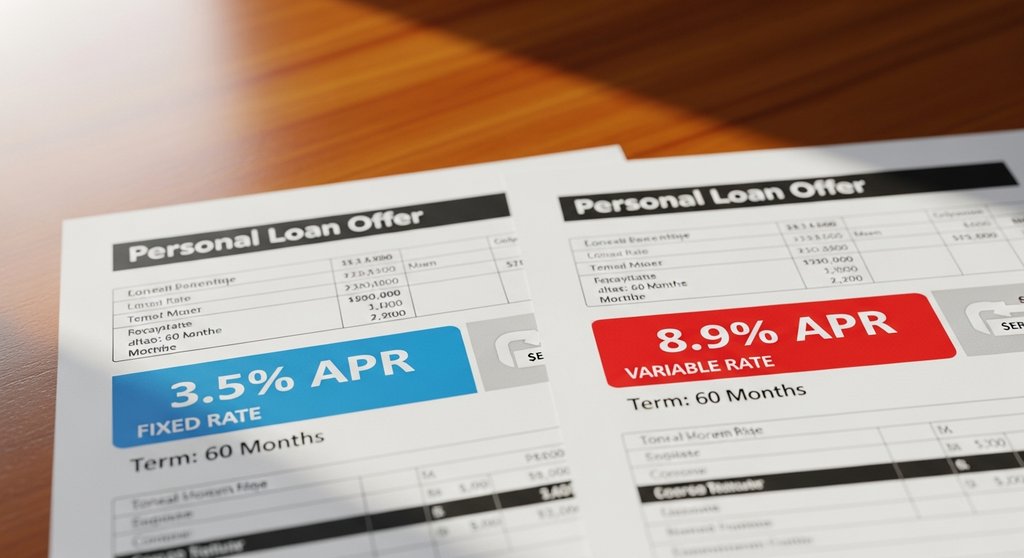
How Loan Fees Hide in Plain Sight on Your APR
Two lenders quote you the same interest rate, but one will cost you thousands more over the life of the loan.
Same Rate, Wildly Different Cost
A 7.25% interest rate sounds like a fixed, apples-to-apples number. It is not. Two competing lenders can both advertise 7.25%, and one of them might fold in a 2% origination fee, a $500 document preparation charge, and prepaid mortgage insurance. The other might charge nothing beyond the interest itself. Those fees do not disappear. They get rolled into the annual percentage rate, which is where the real comparison starts.
The practical gap can be jarring. On a $30,000 personal loan over five years, a 2% origination fee adds $600 upfront. Spread across the loan term, that pushes your effective cost well above 7.25%. A lender quoting 7.25% with those fees will show an APR closer to 8.1%. The competing lender with no origination fee keeps APR at 7.25%. Over 60 months, the difference in total repayment is real money, not rounding error.
Which Fees Actually Move the APR Needle
Not every charge at closing gets folded into APR. Federal Regulation Z, the rule behind the Truth in Lending Act disclosures you receive, specifies which fees lenders must count. Origination fees, discount points, broker fees, and certain prepaid finance charges all go in. Optional services you shop for separately, like title insurance chosen independently, generally stay out. Try the loan APR calculator to see your own numbers.
Points are the sneaky one. One discount point equals 1% of the loan amount and buys down your interest rate. On a $250,000 mortgage, paying two points to drop the rate from 6.9% to 6.5% costs $5,000 upfront. The lower monthly payment looks attractive, but if you sell or refinance within five years, you never recoup that cost. The APR calculation accounts for points and reflects a blended true cost, which is exactly why lenders who lead with low rates but high points often have a higher APR than their headline suggests.
Broker compensation is another common one. Mortgage brokers must disclose their fee, but many borrowers skim past that line on the loan estimate. A 1.5% broker fee on a $400,000 loan is $6,000. It moves the APR upward, and using a loan APR calculator before you agree to anything makes that shift visible immediately.
How to Run the Numbers Before You Commit
The sequence that works: collect the loan estimate from each lender, note the principal, stated interest rate, all itemized fees, and loan term, then run each offer through a loan APR calculator. Within a minute you have an apples-to-apples APR for every quote on your list. That number is the single most useful figure for comparison because it collapses rate and fees into one annual cost.
A worked example: Lender A offers a $20,000 auto loan at 6.5% with a $350 processing fee and a 48-month term. Lender B offers 6.8% with no fees, same term. Plugging both into the calculator shows Lender A at roughly 7.04% APR and Lender B at 6.8%. Lender B is actually cheaper despite the higher stated rate. Without running the APR, most borrowers would pick Lender A and overpay.
One timing note worth knowing: with the Federal Reserve's policy rate still elevated heading into mid-year, lenders across auto, personal, and home equity categories have been competing harder on advertised rates while recovering margins through fees. That environment makes fee scrutiny more important than ever. The gap between a lender's advertised rate and its true APR has widened for many products compared to the low-rate years, so the comparison step is not optional.
When a Higher APR Is Actually the Right Choice
APR is a full-term cost measure, which means it assumes you hold the loan to maturity. If you plan to pay off a personal loan early or refinance a mortgage within three years, a loan with a slightly higher APR but lower fees might cost less in practice. Discount points, for instance, are sunk costs the moment you close. Paying two points to lower your rate makes mathematical sense only if you keep the loan long enough for monthly savings to exceed that upfront cost.
Break-even math is straightforward. Divide the total cost of the points or fees by the monthly savings the lower rate produces. If that break-even period is 48 months and your realistic payoff horizon is 36 months, the lower-rate loan with fees is the losing choice regardless of its APR. Use the APR as your starting filter, then stress-test the result against your actual timeline.