
Why Refinancing Now Could Still Raise Your APR
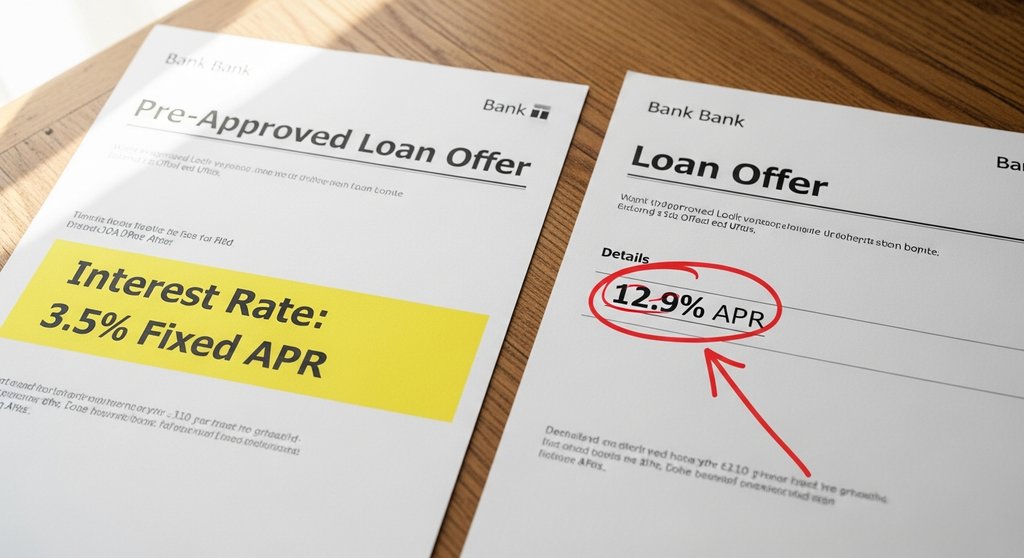
Mortgage and auto loan rates have pulled back from their recent peaks, but borrowers who rush to refinance are discovering their APR is actually climbing.
A Lower Rate Does Not Always Mean a Lower APR
After a prolonged high-rate stretch, lenders are heavily marketing refinance deals with teaser rates that sit a full percentage point below your current note. That sounds like an obvious win. The problem is that refinancing restarts the fee clock.
Origination fees, title searches, appraisals, and prepayment penalties on the old loan all fold into the cost of your new deal. When those charges get spread over a shorter remaining loan life, they can push the annual percentage rate well above the advertised interest rate. A borrower who refinances a $250,000 mortgage with $6,000 in closing costs and only eight years left on a 30-year term is not spreading those costs over 360 payments; they are spreading them over 96. The APR difference can be striking.
The Math That Catches Most People Off Guard
Say you are offered a refinance at 6.4% on a $200,000 balance with $4,500 in lender fees. The advertised rate feels reasonable. But those fees, divided across a fresh 15-year term, add roughly 0.35 percentage points to your true annual cost. Your effective APR lands closer to 6.75%. If your current loan is already at 6.6%, refinancing costs you money on net. Try the loan APR calculator to see your own numbers.
The break-even calculation is equally easy to miss. You need enough monthly savings to recover the closing costs before you sell or pay off the property. If you plan to move in three years and the break-even is four years out, the deal is negative regardless of the rate headline. Running a loan APR calculator with the actual fee amounts included is the fastest way to see this clearly before you sit across from a loan officer.
How Lenders Structure Offers to Obscure the Total Cost
A common tactic right now is the no-closing-cost refinance. Lenders absorb the fees upfront but bake them into a slightly higher interest rate for the life of the loan. On a 30-year term that can mean paying two to three times the original fee amount in additional interest. Borrowers who compare only the monthly payment miss this entirely.
Some offers bundle optional products, such as credit insurance or rate-lock extensions, into the loan amount without clearly labeling them as fees. Under federal Truth in Lending rules, these must be reflected in the disclosed APR, but the disclosure often arrives late in the process when borrowers feel too committed to walk away. Reviewing the APR early, ideally before submitting a full application, keeps negotiating power in your hands.
What to Plug In Before You Commit
Gather four numbers before evaluating any refinance offer: the new loan amount, the interest rate, the full list of fees (ask for the Loan Estimate on day one), and the loan term in months. Those inputs are all you need to calculate a true APR and compare it directly to your current loan.
If the new APR is at least 0.5 percentage points lower than your current rate and your break-even falls within your planned ownership window, refinancing likely makes sense. If those two conditions are not both met, waiting or negotiating lower fees is almost always the smarter play. The difference between a 6.4% and a 6.9% APR on a $300,000 loan over 20 years is roughly $19,000 in extra interest.