
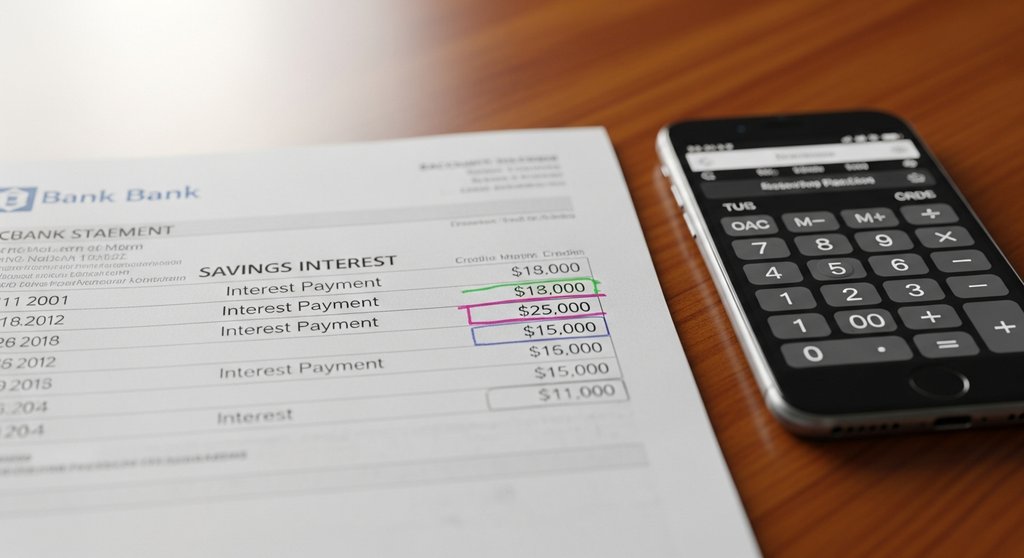
How Compounding Frequency Quietly Grows Your Savings
Two savings accounts can advertise the same interest rate and still pay you very different amounts, and the culprit is almost always how often they compound.
Why the same rate can produce two different balances
Most people assume that if two accounts both advertise 4.5%, they will earn the same money. That is only true if compounding happens at the same frequency. A bank that compounds daily applies a tiny slice of interest to your balance every single day, so each day's interest earns interest the next day. A bank that compounds monthly waits 30 days before doing anything, which means you miss out on nearly a month of growth on each interest payment.
The difference sounds academic until you run the numbers. On a $20,000 deposit at a 4.5% nominal rate, daily compounding produces an APY of roughly 4.603%, while monthly compounding produces about 4.594%. Over one year that gap is around $18. Stretch it to five years and reinvest, and the gap compounds into the hundreds.
Where this actually matters in mid-2026
After a stretch of rate cuts that began in late 2024, many high-yield savings accounts are now hovering in the 3.5 to 4.8 percent range. That is still meaningfully above the near-zero environment of a few years ago, so compounding frequency has real dollar consequences again. Online banks are aggressively competing for deposits right now, and some are advertising the same headline rate with different compounding terms buried in the fine print. Try the annual percentage yield calculator to see your own numbers.
Certificate of deposit shoppers face the same issue. A 12-month CD at 4.6% compounded quarterly is actually less valuable than a 4.6% CD compounded monthly. When you are comparing three or four similar offers side by side, those small APY differences decide which account wins, sometimes by a noticeable margin over a multi-year term.
How to convert nominal rates to APY in under a minute
The formula for APY is (1 + r/n)^n minus 1, where r is the nominal annual rate as a decimal and n is the number of compounding periods per year. For daily compounding, n is 365. For monthly, 12. For quarterly, 4. Plug in 4.5% daily and you get 1.045116 minus 1, or about 4.5116%. Plug in monthly and you get 4.5940%. The formula is simple but easy to get wrong when you are tired and shopping between multiple accounts.
A dedicated annual percentage yield calculator removes the arithmetic risk entirely. Enter the nominal rate and choose compounding frequency, and the tool spits out the true APY instantly. That single number lets you compare any two accounts on an apples-to-apples basis, regardless of what the marketing copy emphasizes.
The practical checklist before you open a savings account
First, find the nominal rate and the compounding schedule in the account's terms and conditions, not the landing page headline. Second, convert every rate you are comparing into APY using the same calculation method. Third, factor in any balance tiers. Some accounts only apply their top rate above $10,000 or $25,000, which can easily outweigh a small APY advantage.
Once you have APYs on the same footing, also check for fees and minimum balances. A 4.7% APY account with a $10 monthly fee on a $5,000 balance effectively earns you closer to 2.5%. The math on compounding only works in your favor if you are not leaking money out the other side on maintenance charges.