
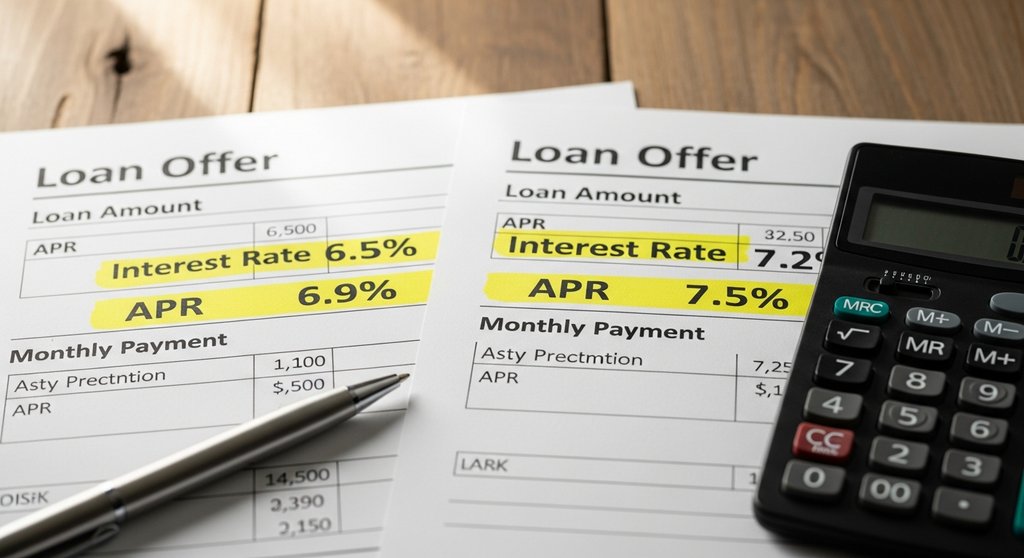
How Loan APR Changes When You Skip the First Payment
Lenders often let you skip your first payment as a sign-up sweetener, but that grace period is rarely free.
The Deferred Payment Perk Is Actually a Cost Shift
When you close a personal loan or auto loan, a lender might say your first payment is not due for 60 or 90 days. That sounds like breathing room. What it really means is that interest is accruing on your full balance from day one, but you are not paying any of it down yet.
By the time you make that first payment, you may already owe several weeks of interest that gets rolled into the remaining balance. The stated interest rate has not changed, but the total cost of borrowing has gone up, which means your true APR, the number that captures all costs over the life of the loan, is now higher than the rate on page one of your contract.
A Real Numbers Example on a $15,000 Auto Loan
Take a $15,000 auto loan quoted at 7.5% interest with a 60-month term and a 90-day deferral. Without the deferral, your monthly payment is roughly $300.57 and your total interest paid over five years is about $3,034. With 90 days of deferred interest added to the balance before payments begin, you are now paying interest on closer to $15,282, pushing total interest toward $3,220 and your effective APR to roughly 8.1%. Try the loan APR calculator to see your own numbers.
That 0.6 percentage point difference might look small on paper, but it represents almost $190 out of your pocket for the privilege of waiting three months to start paying. Running the numbers through a loan APR calculator before you sign lets you see that gap clearly, rather than discovering it buried in an amortization schedule later.
Why Lenders Structure Offers This Way
Deferred payments are a marketing tool, not a financial favor. They reduce the friction of closing a loan, especially on big purchases where a buyer is already stretching a budget. A dealership or online lender knows that most borrowers focus on the monthly payment amount, not the total cost or the APR.
Some lenders also mix a deferred start date with an origination fee. Both factors compound the APR increase independently. A $300 origination fee on that same $15,000 loan adds another 0.4 to 0.6 points to the APR depending on loan length, so a loan that felt like 7.5% could realistically land above 9% in true borrowing cost.
What to Ask Before Accepting a Deferral
Ask the lender two direct questions: does interest accrue during the deferral period, and is that accrued interest added to the principal or waived entirely? If the answer to the first question is yes and the second answer is that it capitalizes into the balance, you are accepting a higher effective APR.
Also check whether the deferral shifts your loan's end date or keeps it fixed. A fixed end date means your remaining payments get slightly larger to absorb the extra cost. A shifted end date means you owe one extra month, which also raises the APR. Neither option is inherently wrong, but you deserve to know which one applies before you drive off the lot or accept the wire transfer.