
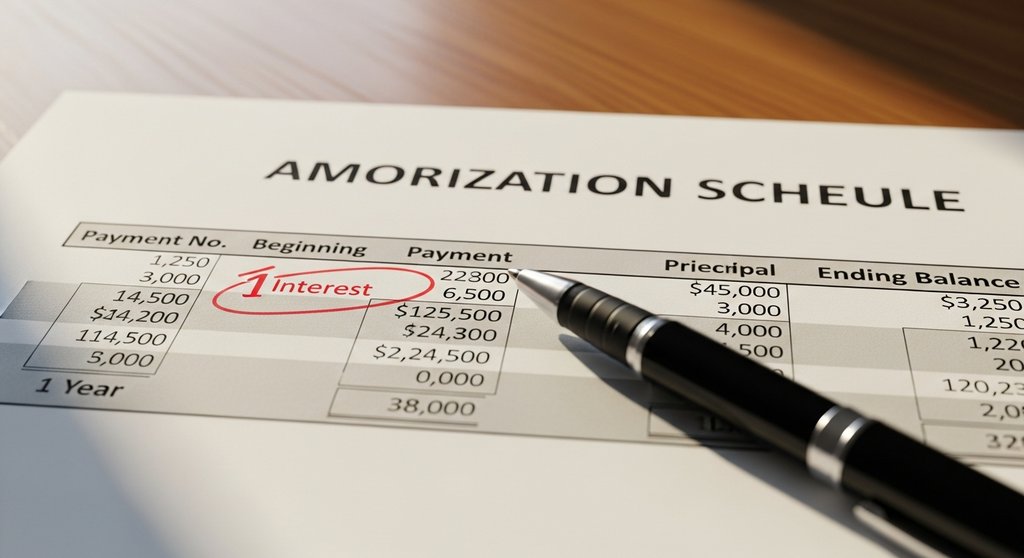
How Loan Term Length Changes Your Total Interest Bill
Most borrowers obsess over the interest rate, but the term length of your loan quietly does far more damage to your wallet.
The Number Borrowers Almost Never Check
When you sit down with a lender, the conversation almost always circles around one number: the interest rate. A quarter-point difference gets treated like a negotiation victory. But the total interest paid over the life of the loan, which sits right there in the fine print, barely gets a glance.
On a $350,000 mortgage at 6.8%, a 30-year term means you pay roughly $468,000 in interest alone by the time the final payment clears. Stretch that discomfort across three decades and it feels abstract. Shrink the term to 15 years and the same loan at a slightly lower rate (say 6.2%) costs around $192,000 in interest. That is a $276,000 difference, not from shopping for a better rate, but simply from choosing a shorter repayment window.
Why a Shorter Term Costs Less Even at a Higher Payment
The monthly payment on a 15-year loan is noticeably higher. On that same $350,000 example, a 30-year term produces a payment around $2,300 per month. A 15-year term pushes that to roughly $3,000. For many households that $700 monthly gap feels like a dealbreaker, so they default to the longer term without doing the full math. Try the loan amortization calculator to see your own numbers.
Here is the part worth understanding: you are not just paying longer with a 30-year loan, you are paying on a larger remaining balance for longer. Interest accrues daily on whatever balance is outstanding. A slow paydown schedule means a slow reduction in that balance, which means more days of interest compounding on more principal. The math compounds against you in a way that the rate alone does not fully capture.
Mid-2026 mortgage rates have stabilized in the mid-to-upper 6% range after a few years of volatility. That environment makes the term decision especially consequential. Rates are not low enough to make the 30-year feel cheap, so the long-term interest burden is substantial.
Personal Loans and Auto Loans Have the Same Problem
This is not a mortgage-only issue. Auto lenders have been pushing 72- and 84-month loan terms for several years now because they make the monthly payment look manageable. A $45,000 vehicle loan at 7.5% over 84 months costs about $13,200 in interest. The same loan paid over 48 months costs roughly $7,100. You save over $6,000 just by tolerating a higher monthly payment for a shorter period.
Personal loans carry the same dynamic. Borrowers who take a 7-year personal loan to consolidate credit card debt often end up paying nearly as much in interest on the personal loan as they were paying on the cards, just spread out differently. The consolidation feels like progress, but the total cost may not be.
Running the Real Numbers Before You Sign
The practical fix is simple: look at the total interest figure, not just the monthly payment, before committing to any loan term. A good loan amortization calculator lets you plug in the principal, rate, and term and immediately shows you the cumulative interest for every month of the loan. You can also run two or three scenarios side by side to see exactly what changing the term by five years does to your long-term cost.
If you are in the middle of weighing a loan offer right now, spend ten minutes with a loan amortization calculator before signing anything. The monthly payment your lender quotes is a monthly convenience. The total interest you owe is the actual price of the loan, and those two numbers tell very different stories.