
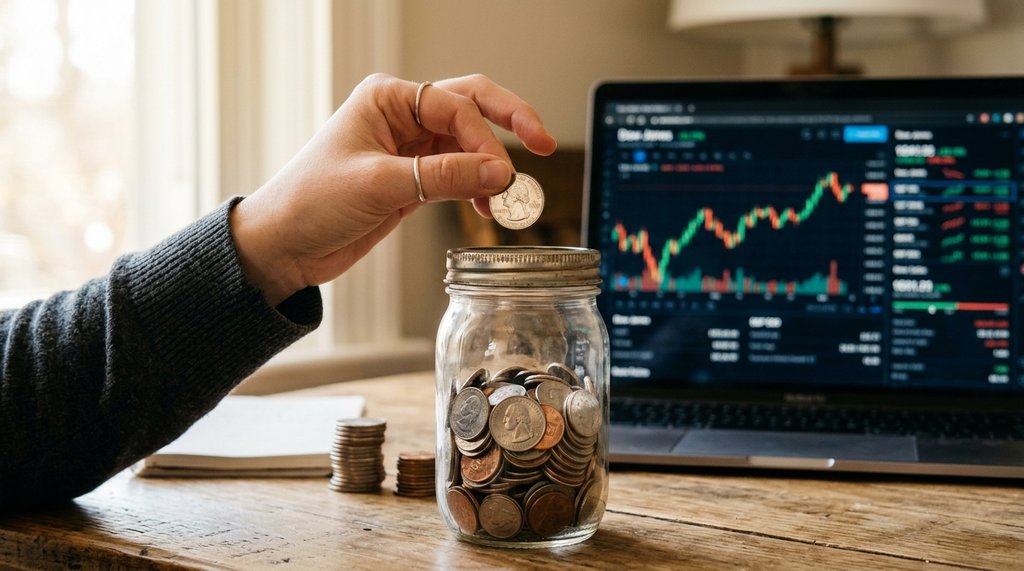
How Much Does Skipping One DCA Payment Actually Cost You?
Most investors obsess over which assets to buy with dollar cost averaging, but far fewer think about what happens when they quietly skip a month.
The 'I'll Double Up Next Month' Trap
Life gets expensive. A car repair, a higher grocery bill, an unexpected dental visit. When cash is tight, that scheduled $300 investment is often the first thing to pause. The reasoning feels sound: one month off won't matter, and you'll catch up later.
The problem is that 'later' rarely looks like a clean double contribution. Studies of household investing behavior consistently show that skipped payments tend to stay skipped, or get replaced with a smaller amount rather than the promised catch-up. One missed $300 contribution at a moment when markets dipped is not just $300 gone. It's the shares you would have bought cheaply, and all their future growth.
Running the Numbers on a Single Missed Month
Take a straightforward scenario. You invest $300 every month into a broad index fund starting January 1 of a given year, targeting a 7% average annual return over 20 years. A dollar cost averaging calculator shows your total portfolio value after 240 payments comes to roughly $196,000. Try the dollar cost averaging calculator to see your own numbers.
Now skip month 13, a month when the market happened to be down 8%. You invest $0 instead of $300. Your final balance drops by more than the $300 itself. Because that particular month offered discounted shares, missing it costs you closer to $520 in ending value after compounding. That's a 73% penalty on a single skipped payment, simply because timing worked against you.
The math gets worse the earlier in the investing window you skip. A missed payment in year two of a 25-year plan can cost three to four times its face value by the end of the period, because compounding has the most runway to work with early on.
Why Mid-2026 Makes Consistency Especially Valuable
After a volatile stretch for global equities in the first half of this year, a lot of retail investors have been tempted to pause contributions and 'wait for clarity.' That impulse is understandable, but it is also precisely when DCA is designed to work hardest for you. Choppy, sideways, or recovering markets are the conditions where buying at intervals lowers your average cost per share most effectively.
Pausing during uncertainty means you sit out the dips that ultimately pull your average cost down. When the market eventually recovers, as it historically does, investors who stayed consistent hold more shares at a lower average price than those who paused and re-entered at higher levels.
Building a 'Never Skip' Buffer Into Your Budget
The simplest fix is to treat your DCA contribution the way you treat a utility bill, non-negotiable and automated. If $300 a month feels fragile against unexpected expenses, consider dropping the amount to $200 and keeping a small cash buffer separately. A consistent $200 beats an inconsistent $300 almost every time over a 15-plus-year horizon.
You can test different contribution amounts, frequencies, and return assumptions with a dollar cost averaging calculator to find the number that genuinely fits your cash flow. The goal is a figure you will not skip when life gets expensive, because the habit of staying in the market is worth more than the occasional larger deposit.
Automating the transfer the day after your paycheck lands also removes the decision entirely. When the money is already moved, there is nothing to debate during a stressful week.