
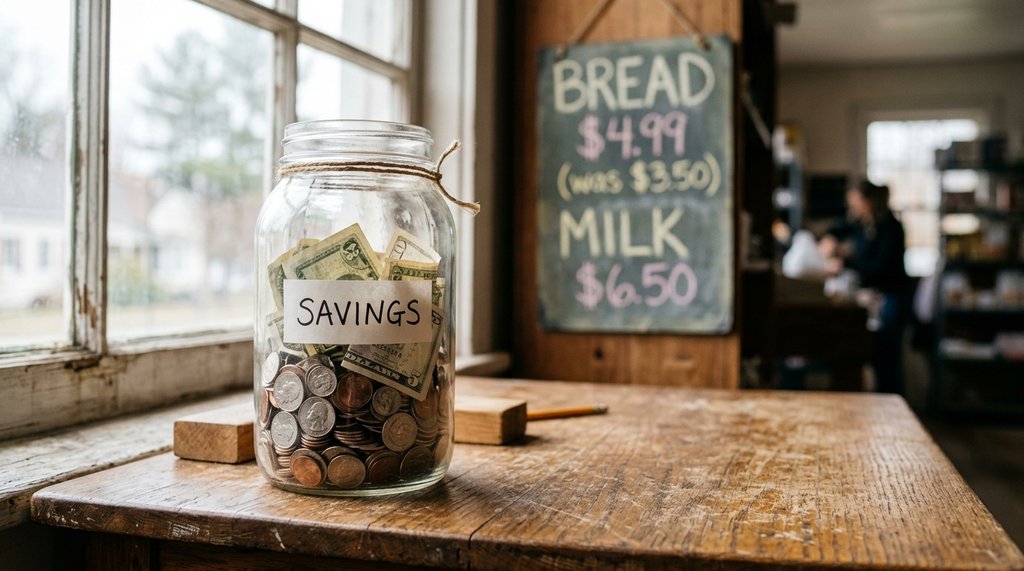
What $1,000 in Pandemic Savings Is Actually Worth Now
Millions of Americans built up cash reserves during 2020 and 2021, but the inflation wave that followed has silently eroded every dollar they set aside.
The Illusion of a Healthy Savings Balance
A lot of households look at their savings account today and feel pretty good. The number on the screen is the same as it was a few years ago, maybe even a little higher thanks to interest. But that number is deceiving you, because dollars from 2020 and 2021 do not buy what dollars buy right now.
Between January 2020 and the middle of this decade, cumulative inflation added up to somewhere around 23 to 25 percent depending on the category. That means $1,000 saved in early 2020 needs to be roughly $1,230 to $1,250 today just to represent the same purchasing power. If your account has not grown by at least that much, you have lost ground, even if the balance looks stable.
Why Pandemic-Era Savers Got Hit Especially Hard
The timing was particularly brutal for people who saved aggressively during 2020 and 2021. Stimulus payments, reduced spending on travel and dining, and remote-work cost savings pushed household savings rates to historic highs. Many people parked that cash in standard savings accounts earning close to zero percent. Try the inflation adjusted value calculator to see your own numbers.
Then inflation arrived faster than most economists predicted. Anyone who saved $10,000 during those years and left it in a low-yield account effectively watched it shrink to roughly the equivalent of $8,000 in today's purchasing power. The money never moved. The world around it did.
Running the Numbers on Your Own Situation
The simplest way to see the real damage is to pick a specific year, enter the amount you saved, and calculate what it would need to be worth today to match its original value. An inflation adjusted value calculator does exactly that using CPI data, so you get a concrete answer rather than a rough guess.
Try it with a few scenarios. Enter $5,000 from 2020 and see how much that translates to in current dollars. Then enter the actual balance you have today. The gap between those two figures is your real loss. For many people, that gap runs into hundreds or even thousands of dollars per year of accumulated savings.
What This Means for Your Financial Plan Right Now
Recognizing the erosion is not just an exercise in feeling bad. It tells you whether your emergency fund is actually adequate or whether it only looks adequate. Most financial guidance recommends three to six months of expenses in liquid savings. But if your expenses have risen with inflation and your savings have not, you may be sitting on four months of 2021 expenses rather than four months of today's expenses.
The fix is not necessarily dramatic. High-yield savings accounts in mid-2026 are still paying rates that come closer to keeping pace with current inflation than the near-zero options available in 2020 and 2021. Moving idle cash into one of those accounts stops the bleeding going forward. But first, you have to see clearly how much you have already lost, which is exactly the kind of concrete reality check that makes recalibrating your savings targets feel urgent rather than optional.