
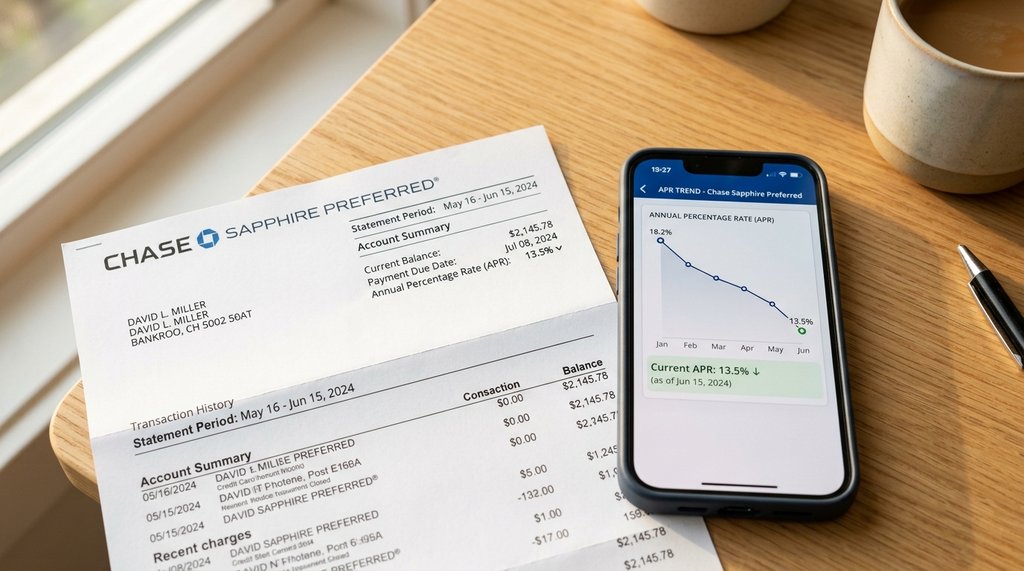
What Happens to Your APR When the Fed Cuts Rates
After months of anticipation, the Fed has trimmed rates again, and millions of cardholders are checking their statements expecting relief that may never arrive.
Variable APRs Follow the Fed, but Only Part of the Way
Most credit cards carry a variable APR tied to the prime rate, which moves in lockstep with the federal funds rate. When the Fed cuts by 25 basis points, your card's APR technically drops by the same amount. On a $5,000 balance, that 0.25% reduction saves you about $12.50 a year in interest. That is not a rescue; it is a rounding error.
The reason the impact feels invisible is that the prime rate is only one piece of your APR. Card issuers stack a margin on top, often ranging from 12% to 22%, and that margin does not move when the Fed does. So if your current APR is 27.49% and the prime drops by half a point, you end up at 26.99%. The daily periodic rate barely budges.
How Daily Compounding Swallows Rate-Cut Gains
Credit card interest compounds daily, not monthly. Your issuer divides your APR by 365 to get a daily periodic rate, then applies it to your average daily balance each day. At 27%, that daily rate is about 0.0740%. At 26.5% after a 50-basis-point cut, it falls to 0.0726%. On a $4,000 revolving balance, the monthly difference is roughly $2.80. Most people spend more than that on a single coffee run. Try the credit card APR calculator to see your own numbers.
This is exactly why running the numbers yourself matters. A credit card APR calculator can show you your actual monthly interest charge and your true annual cost based on your specific balance, not a textbook example. Plug in your current balance and rate, then plug in the post-cut rate. The gap will likely surprise you in the wrong direction.
The Scenario Where a Rate Cut Actually Helps: Large Balances Over Long Payoffs
There is one situation where Fed cuts produce a meaningful difference: someone carrying a high balance over a long payoff timeline. Take $15,000 at 28% APR paid down with $400 monthly payments. That balance costs roughly $8,200 in total interest and takes about 52 months to clear. Drop the APR to 27% and total interest falls to about $7,800, saving $400 and cutting one month off the payoff schedule. Still modest, but real money.
The lesson here is not to wait for rate cuts to solve a debt problem. Even if the Fed cuts three times in a row for a cumulative 75 basis points, the structural cost of carrying revolving credit card debt remains enormous. A rate environment that felt punishing at 28% still punishes at 27.25%.
If you want to see exactly where you stand, use our credit card APR calculator to map out your payoff timeline and total interest costs under your current rate and any hypothetical lower one. The comparison is sobering but useful.
What Actually Moves the Needle on Your Card Costs
Transferring to a 0% promotional balance transfer card, paying more than the minimum each month, or eliminating the balance entirely all produce results that dwarf anything a quarter-point Fed cut can deliver. A cardholder with $6,000 at 27% APR who bumps monthly payments from $150 to $250 saves over $3,000 in interest and shaves nearly three years off the payoff. No central bank decision comes close to that kind of impact.
Rate cuts are worth tracking if you carry debt, but they should not change your strategy. The move that actually matters is reducing the balance itself. Fed policy is background noise compared to your payment habits.