
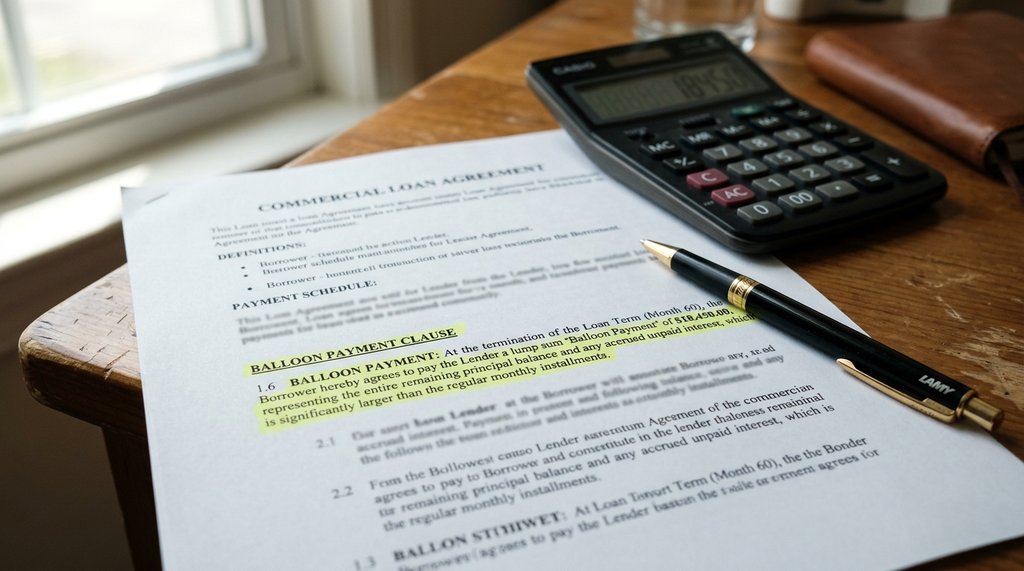
How a Balloon Payment Quietly Inflates Your Loan APR
Balloon payment loans are making a comeback in auto and personal lending, and most borrowers have no idea how much the lump-sum ending inflates their true annual cost.
Why balloon loans look so attractive right now
With benchmark rates still sitting above 5%, lenders have been rolling out balloon-payment structures to keep monthly payments low enough to close deals. The pitch is simple: pay a small amount each month for three or five years, then settle the remaining balance in one big payment at the end. On a $30,000 auto loan, that can mean payments of $350 instead of $620 a month.
The catch is that a balloon structure front-loads your interest exposure. Because you're carrying a large unpaid principal for almost the entire loan term, interest accrues on a much bigger balance for much longer than a fully amortizing loan would allow. The monthly payment looks affordable, but the total interest paid over the life of the loan is far higher.
The APR math that lenders rarely show you
Suppose you borrow $30,000 at a stated 7% interest rate with a 5-year term, but a $15,000 balloon payment due at month 60. Your monthly payment drops to about $438. Sounds reasonable. But when you account for the total interest paid across all those payments plus the balloon, the APR often clears 8.5% or higher depending on origination fees. That half-point gap may look small, but on a $30,000 loan it adds up to roughly $900 in extra interest over five years. Try the loan APR calculator to see your own numbers.
Most lenders disclose APR in the fine print of the loan agreement, but the number can be easy to miss, especially when the conversation is focused on monthly affordability. Running the numbers yourself before you sit across from a financing officer gives you a real baseline for comparison.
What happens if you cannot cover the balloon
This is the scenario borrowers underestimate most. If the balloon comes due and you cannot pay or refinance, you either default or accept whatever rate the lender offers on a new loan at that moment. In a market where rates have moved up even slightly, that rollover loan could carry a higher APR than your original agreement, effectively compounding the cost.
Stress-testing this scenario in advance is worth the effort. Calculate what your total borrowing cost looks like if you refinance the balloon at a rate 1 or 2 percentage points higher than today. The true cost of that convenience-driven low monthly payment can become clear very quickly.
A loan APR calculator that handles non-standard payoff structures, including balloon amounts, lets you model both the original deal and the worst-case rollover side by side. That comparison is the most useful thing you can do before committing to this type of financing.
How to use APR as your decision filter
When you have two loan offers in front of you, one fully amortizing and one with a balloon, do not compare monthly payments. Compare APRs on equal terms, meaning the same loan amount and the same assumption about what happens at the balloon date. If you plan to sell the asset before the balloon comes due, that changes the math; if you are unsure, assume you will hold it to term.
The loan APR calculator on this site lets you plug in the balloon amount separately, so you get a clean comparison against a standard loan rather than a misleading payment-to-payment contrast. Use that number as your filter, and the structure that looks attractive on a payment sheet often looks much less so once the real annual cost is in plain view.