
Why BMI Alone Cannot Tell You If You Are Healthy
Millions of people check their BMI and walk away with a false sense of either relief or alarm, because the number is more limited than most health messaging admits.
What BMI actually measures, and what it skips
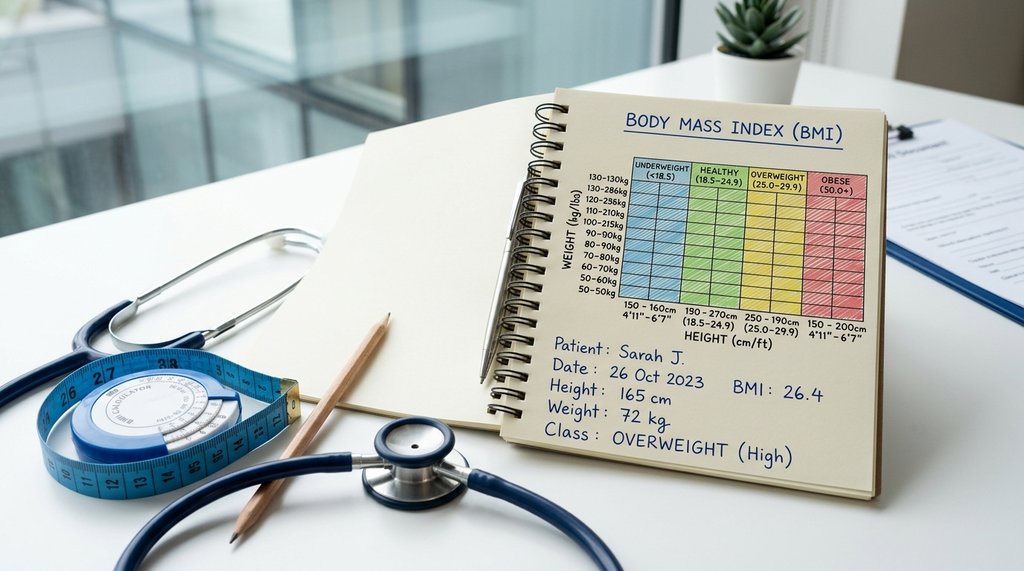
Body Mass Index is a simple ratio: your weight in kilograms divided by your height in meters squared. A score between 18.5 and 24.9 is labeled 'normal,' 25 to 29.9 is 'overweight,' and 30 or above is 'obese.' The formula was developed by Belgian statistician Adolphe Quetelet in the 1830s to describe population averages, not to diagnose individual health.
The core problem is that BMI cannot distinguish between fat and muscle. A 200-pound marathon runner and a sedentary 200-pound person of the same height receive the same score. Elite athletes routinely land in the 'overweight' category despite having low body fat and excellent cardiovascular health. At the same time, someone with a 'normal' BMI can carry dangerous visceral fat around their organs, a condition researchers sometimes call 'normal weight obesity.'
Why insurers and clinicians still rely on it in 2026
Despite decades of criticism, BMI persists in clinical and insurance settings for one practical reason: it is fast, free, and requires no lab equipment. Many employer wellness programs and life insurance underwriters still use BMI thresholds to set premiums or flag participants for health coaching. The American Medical Association formally acknowledged BMI's limitations back in 2023, recommending it be used alongside waist circumference, body composition scans, and metabolic bloodwork. Progress on actually replacing it in routine practice has been slow. Try the body mass index calculator to see your own numbers.
Some newer tools are gaining ground. DEXA scans measure lean mass versus fat mass directly, and waist-to-height ratio (your waist circumference divided by your height) has strong evidence for predicting cardiovascular risk. A ratio above 0.5 signals elevated risk regardless of what BMI says. These methods cost more time or money, which is why the old formula keeps showing up on intake forms.
How to use your BMI number without over-reading it
BMI works reasonably well as a population-level screening signal and as one data point in a broader health picture. If your score is 35 or above, that is meaningful information worth discussing with a doctor. If you are 26 and active, a single digit into the 'overweight' range tells you almost nothing useful on its own.
A practical approach: start with the number, then add context. Check your waist circumference (health risk rises above 35 inches for women and 40 inches for men), ask your doctor about fasting glucose and triglycerides, and think about your fitness trend over time. Using a body mass index calculator takes about 10 seconds and gives you a reasonable starting point, but treat it as the first question, not the final answer.
If you want to track changes over months, BMI is actually useful for that narrow purpose because the formula is consistent. A drop from 31 to 28 over six months, combined with improving blood pressure, is a signal worth celebrating. The number earns its keep when it is one piece of evidence among several, not when it stands alone as a verdict.
Race, age, and sex create real gaps in BMI accuracy
Standard BMI thresholds were derived mostly from data on white European populations. Research has consistently shown that people of Asian descent face elevated metabolic risk at lower BMI scores, which is why the World Health Organization has suggested lower cutoff points (around 23 for overweight) for Asian populations. Conversely, some studies suggest Black adults may have lower disease risk at the same BMI compared to white adults, meaning the 'obese' label may overestimate risk in some cases.
Age adds another layer. Older adults naturally lose muscle mass and gain fat even when their weight stays steady, so a 70-year-old with a 'normal' BMI might have significantly more body fat than a 30-year-old at the same score. For kids and teens, BMI is calculated differently, using age-and-sex-specific percentile charts rather than fixed cutoffs. Adults often do not realize their own childhood BMI was interpreted on a completely different scale.