
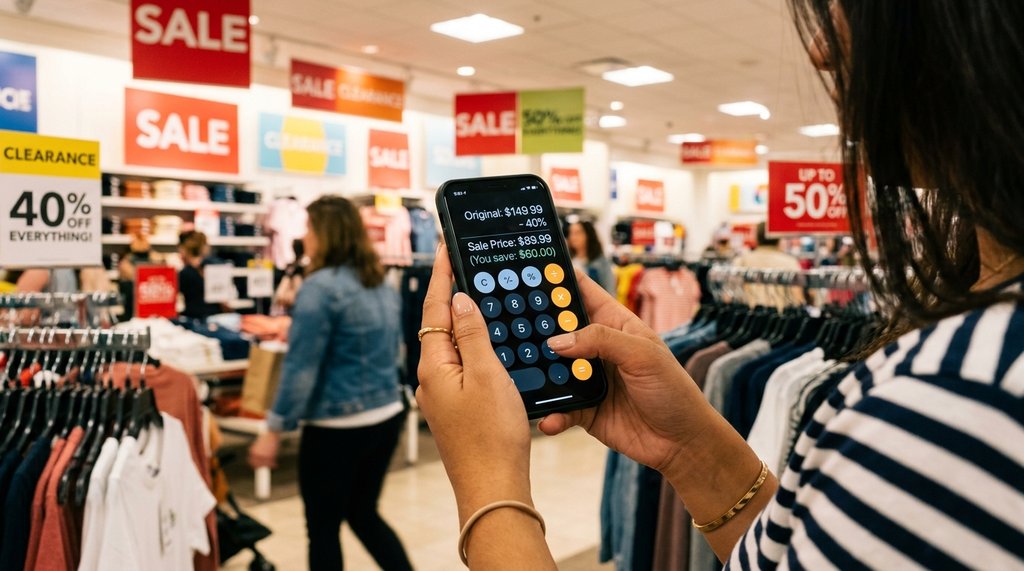
Why Most People Calculate Percentages Wrong at Checkout
Retail stores are running some of the deepest discount events seen in years this late-August shopping season, and that makes knowing your actual savings more valuable than ever.
The stacked discount trap everyone falls for
A shirt is marked 40% off, and then you have a loyalty coupon for an extra 20% off. Most shoppers mentally add those together and expect 60% off the original price. That is not how it works. The second discount applies to the already-reduced price, not the original tag.
On a $100 shirt, 40% off brings you to $60. Then 20% off $60 takes another $12, landing you at $48. Your real savings are 52%, not 60%. An eight-point gap might sound small, but on a $400 jacket that difference is $32 you thought you were saving but weren't.
Retailers know this. Stacked promotions feel more generous than they are. Running the actual numbers before you reach the register is the only way to know what you're genuinely paying.
Percentage of what, exactly? The base-number problem
The most common percentage mistake isn't the math itself; it's choosing the wrong starting number. "Sales are up 15%" means nothing without knowing 15% of what figure, over what period, compared to what baseline. Try the percent calculator to see your own numbers.
This same confusion hits personal finances hard. If your rent rises from $1,800 to $2,100, that's a 16.7% increase, not a flat $300 problem. But if your salary went from $2,100 to $1,800, that's a 14.3% cut, not the same percentage in reverse. A decrease and an increase of the same dollar amount produce different percentages because the denominator changes.
Getting the base right matters even more during tax season. Claiming a deduction worth "20% of your home office" requires knowing 20% of total square footage, not just estimating a room's size. Small base errors compound into real dollar differences on a return.
Tip calculations that quietly cost you more than you think
Restaurant bills have quietly grown more complex. Many point-of-sale screens now suggest tip percentages calculated on the pre-tax subtotal, but some calculate them on the post-tax total. On a $90 meal with 10% local tax, a 20% tip on the $99 total is $19.80 versus $18 on the pre-tax amount. Over a summer of dining out, that gap adds up.
There's also the mental shortcut that breaks down on larger bills. Doubling the tax to estimate a tip works in cities with roughly 8% to 9% sales tax, but in states like Louisiana or Tennessee where combined rates can hit 10% to 11%, doubling the tax overshoots a standard 20% tip. Using a percentage calculator directly cuts through all of that ambiguity.
A fast three-step check before any big purchase
First, identify the original base price, not the displayed sale price. Second, apply each discount or fee sequentially rather than adding percentages together. Third, verify whether any quoted percentage is a change relative to the old number or a percentage of a new total.
For anything over about $50, doing this mentally is slow and error-prone. A reliable percent calculator handles all three question types: what is X% of a number, what percentage is one number of another, and what is the original value if you know a percentage and a result. Having that tool open on your phone during a shopping trip takes seconds and can save real money.
The back-to-school and late-summer clearance window tends to pack a lot of stacked promotions into a short stretch. Stores competing hard on price are also competing on making those prices look bigger than they are. Knowing the exact math is your fastest defense.