
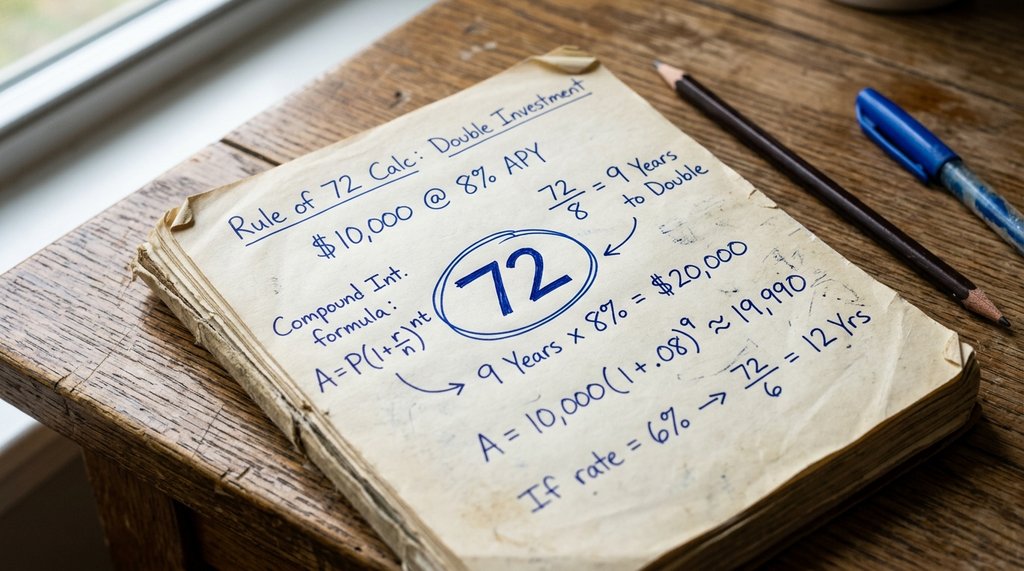
Rule of 72: The Shortcut Investors Keep Getting Wrong
The Rule of 72 is one of the most useful mental math tricks in personal finance, but a surprisingly common misapplication quietly costs people years of compounding time.
The mistake almost every beginner makes
The rule is simple: divide 72 by your annual return rate and you get the number of years it takes to double your money. At 6%, that is 12 years. At 9%, it is 8 years. Clean, fast, no calculator required.
The problem is what people plug into that formula. Most beginners use the nominal rate they see advertised on a savings account or fund prospectus, not the after-inflation or after-tax return. That gap is enormous right now. A high-yield savings account advertising 4.8% sounds great, but with core inflation still running near 3.1% through mid-2026, your real purchasing-power return is closer to 1.7%. Divide 72 by 1.7 and your money takes 42 years to double in real terms, not 15.
Why the after-tax number hits even harder
Inflation is only half the erosion. If that 4.8% savings interest sits in a taxable account and you are in the 22% federal bracket, you keep roughly 3.75% after tax. Subtract inflation and your real after-tax return drops to about 0.65%. At that rate, the Rule of 72 says it takes 110 years to genuinely double your spending power. That is not a rounding error; it is a retirement plan falling apart. Try the rule of 72 calculator to see your own numbers.
The fix is to run three separate calculations: one on the nominal rate, one on the after-tax rate, and one on the after-inflation rate. Those three numbers tell you three different stories, and only the last one tells you how much wealthier you are actually becoming. A doubling-time calculator built around the Rule of 72 lets you test all three scenarios in seconds without doing the division by hand each time.
This matters even more for investors comparing a tax-advantaged 401(k) earning 7% versus a taxable brokerage account earning the same 7%. The 401(k) doubles in about 10.3 years. The taxable account, for that same 22% bracket investor, doubles in roughly 13 years. That three-year gap compounds painfully over a 30-year career.
A real scenario: comparing two savings paths right now
Say you have $25,000 and you are deciding between a 5.1% CD and an S&P 500 index fund with a historical average closer to 10%. The CD doubles nominally in about 14 years (72 / 5.1). The index fund doubles in roughly 7.2 years (72 / 10). But strip out a 3.1% inflation assumption and the CD's real return is just 2%, meaning it takes 36 years to double your purchasing power. The index fund's real return of about 6.9% gets you there in roughly 10.4 years.
Those numbers assume the index fund is in a Roth IRA, where growth is tax-free. Shift it to a taxable account and add the 15% long-term capital gains rate for a middle-income earner, and the effective real return drops closer to 5.9%, which still doubles purchasing power in about 12.2 years. Still vastly better than the CD, but the gap narrows in ways most people never quantify.
How to use the Rule of 72 the right way going forward
Start with your nominal rate, then subtract your effective tax drag, then subtract your expected inflation rate. Use that final number as your input. If the result is negative or below 1%, the investment is not growing your wealth in any meaningful sense, no matter what the headline rate says.
The rule is most accurate for rates between 6% and 10%. Outside that range, it starts to drift. At very low rates, the rule slightly underestimates doubling time; at rates above 12%, it slightly overestimates. For those edge cases, a dedicated rule of 72 calculator gives you a precise figure instantly, and lets you toggle between nominal, real, and after-tax inputs so you are always comparing apples to apples.
The bigger discipline is running this check before you commit capital, not after you have already locked in a rate. Three minutes of math at the decision point can shift a 30-year retirement outcome by a meaningful margin.