
Why Your Loan's Interest Rate and APR Are Never the Same Number
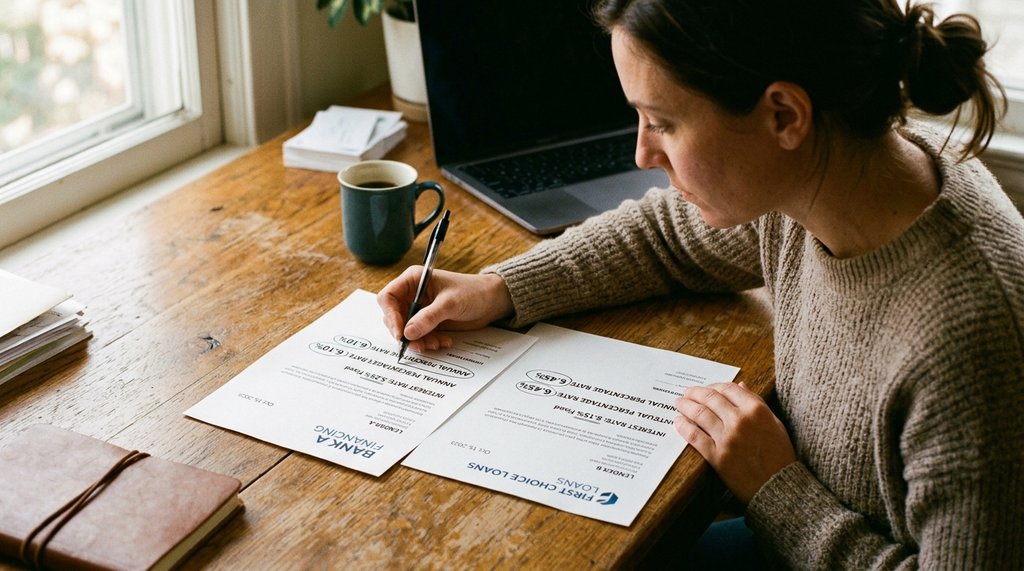
Lenders advertise interest rates because they look smaller, but the APR is the number that actually tells you what you will pay.
The fee that makes your rate a fiction
A lender quotes you 6.9% on a personal loan. You compare it to another lender offering 7.2%. Easy choice, right? Not quite. The first lender charges a 2% origination fee on a $20,000 loan. That upfront $400 charge, spread across a 36-month term, pushes the true annual cost closer to 8.3%. The advertised rate was almost a point and a half lower than reality.
This is exactly what the Annual Percentage Rate is designed to fix. APR folds origination fees, broker fees, and certain closing costs into a single annualized figure so you can compare two loans on equal footing. Federal law requires lenders to disclose APR under the Truth in Lending Act, but nothing stops them from making the stated interest rate the largest number on the page.
What a 7% rate at current fee levels actually costs per month
With personal loan rates sitting in the high-single digits after several years of elevated Fed policy, fees have become a bigger slice of the total cost pie. A $15,000 home-improvement loan at 7.5% with a 3% origination fee over 48 months carries an APR of roughly 9.6%. Monthly payments feel similar to a no-fee loan at 7.5%, but over four years you hand the lender about $320 more than the rate tag suggests. Try the loan APR calculator to see your own numbers.
The gap grows on shorter terms. Origination fees are fixed dollar amounts. Spread a $450 fee across 24 months instead of 60, and the APR penalty almost doubles. Borrowers who take shorter terms to save interest often underestimate how much those upfront fees bite back. Running the numbers before you sign is not optional; it is the whole game.
Using a loan APR calculator before accepting any offer takes about 90 seconds and surfaces exactly this gap. Plug in the loan amount, interest rate, term, and any fees, and you get the real APR alongside a month-by-month amortization table.
Why auto and mortgage APR disclosures still confuse people
Mortgage APR includes discount points, lender fees, and mortgage insurance premiums, which makes it genuinely useful for comparing 30-year loans from different banks. But on a loan you plan to pay off in seven years, a lower APR built on discount points can actually cost more than a higher APR with no points. The APR assumes you hold the loan to maturity. If you refinance or sell early, you paid points for nothing.
Auto loan APR is usually cleaner because dealer financing rarely involves points. The wrinkle there is the dealer reserve, a markup on the rate the dealer earns as profit. A 6.4% quoted rate might reflect a 5.9% buy rate from the lender plus a 0.5% dealer markup. The disclosed APR will include that markup, so at least you see the true annualized cost, even if you cannot easily separate the dealer's cut from the base rate.
A practical checklist before you accept any loan offer
Ask every lender for the APR in writing before you commit. Federal rules require disclosure before consummation, not just at signing. Request an itemized fee schedule so you know exactly which charges are folded into the APR and which, like title insurance on a mortgage, are excluded. Some fees appear in closing costs but not in APR calculations, which means even the APR can understate total cost.
Compare loans with identical terms first. An APR comparison only works cleanly when loan amounts and repayment periods match. A $10,000 loan at 8.9% APR over 36 months and a $10,000 loan at 8.1% APR over 60 months have wildly different total interest payouts despite looking close on paper. Lock the term, then sort by APR, and you have a defensible apples-to-apples comparison.