
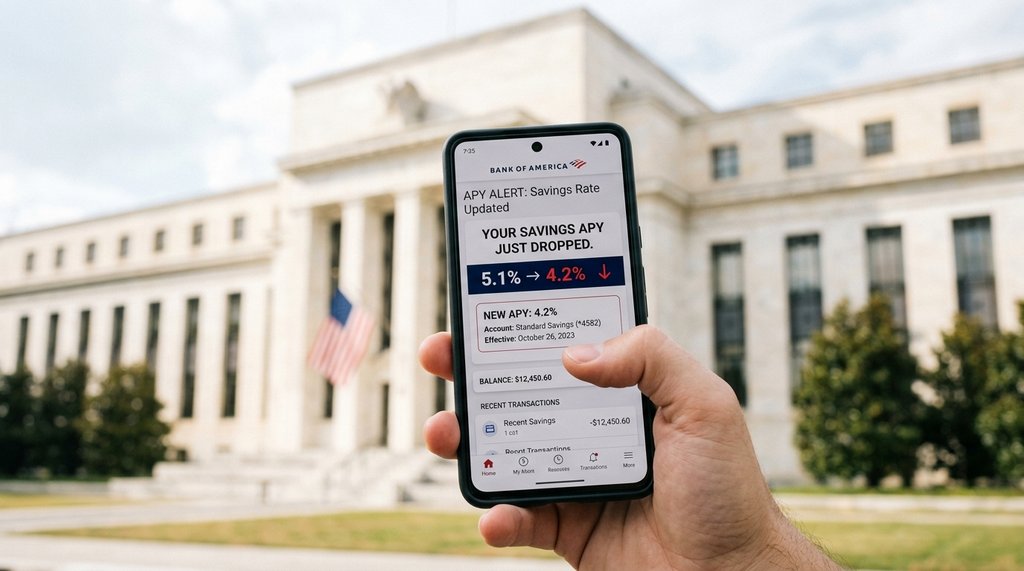
What Happens to Your APY When the Fed Cuts Rates
When the Federal Reserve lowers its benchmark rate, your high-yield savings account quietly starts paying you less, sometimes within days.
Banks move fast when rates fall
The Fed does not set your savings rate directly. But online banks and credit unions price their deposit products very close to the federal funds rate, so when the Fed cuts by 0.25%, your APY often drops by a nearly identical amount within a week or two.
That is not a coincidence. Banks want deposits when rates are high and competition is fierce. When the Fed signals cuts, they have less pressure to keep rates attractive, and they act on that quickly. A rate that was 5.10% APY in early 2024 could realistically sit below 4% by the time a full cycle of cuts plays out.
A 1% APY drop costs more than most people expect
Say you have $25,000 in a high-yield savings account at 5.00% APY, compounded daily. After one year, you earn roughly $1,282. Drop that APY to 4.00%, and you earn about $1,020. That is $262 less, simply because the Fed trimmed its benchmark rate by one percentage point across several meetings. Try the annual percentage yield calculator to see your own numbers.
The math gets steeper with larger balances. At $80,000, that same 1% APY reduction shaves around $840 from your annual interest. Most people never calculate this because they focus on the current rate, not what a downward shift actually means in dollars. Using an annual percentage yield calculator with your real balance and a projected lower rate gives you that number in seconds.
The compounding frequency matters here too. Daily compounding turns that stated rate into a slightly higher effective yield than monthly compounding does. When your bank quietly switches from daily to monthly compounding alongside a rate cut, the combined effect is larger than the rate headline alone suggests.
How to use a rate-cut scenario to make a smarter deposit decision
One practical move before a widely expected Fed cut: lock in a certificate of deposit. A 12-month or 18-month CD lets you hold a fixed APY even after the Fed moves. The trade-off is liquidity, since early withdrawal usually costs you several months of interest. Whether that trade-off is worth it depends on the yield gap and how long you can leave the money untouched.
Run both scenarios side by side. Take the current APY on your savings account, then model what happens if it drops by 0.50% or 1.00% over the next year. Do the same calculation for a fixed-rate CD at whatever rate is available today. The difference in total interest earned tells you how much you are paying for the flexibility of keeping money in a savings account.
This kind of planning is especially relevant for people holding emergency funds above the three-to-six-month threshold. Any surplus sitting in savings purely for yield is a candidate for a short-term CD ladder, where you split the money across CDs with different maturity dates so some portion stays accessible every few months.
One number worth checking right now
Pull up your current savings account APY and your balance, then run a comparison using a rate that is 0.75% lower. That is a realistic cumulative cut across two or three Fed meetings. The output shows you the actual dollar difference over 12 months, which is more motivating than any percentage point discussion.
Most people discover they are earning less than they assumed once they see the hard number rather than the advertised rate. The gap between what you think you will earn and what you actually receive is exactly the kind of thing a dedicated annual percentage yield calculator surfaces without any guesswork.