
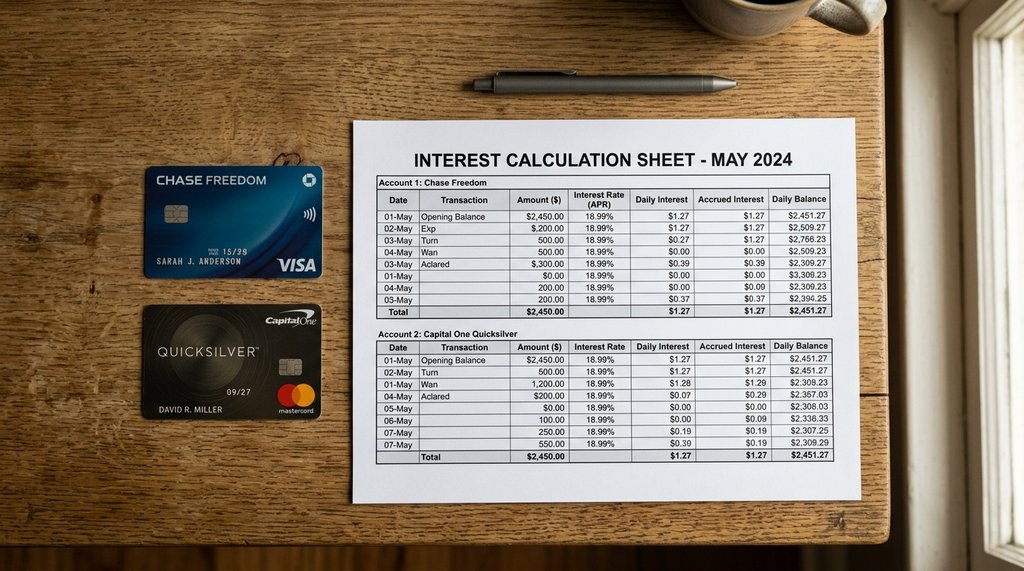
New Card, Same Debt: How APR Follows Your Balance
Adding a second credit card to solve a cash-flow problem sounds logical, but the math of carrying balances on two cards at different APRs usually makes things worse, not better.
Why Two Cards With 'Lower' APRs Can Cost More Than One
Say you have $3,000 on a card at 27% APR and you open a new card with a 20% APR to spread the load. You move $1,500 to the new card and feel like you've cut your interest rate almost in half. You haven't. You now have two separate daily periodic rates compounding simultaneously, and your total interest bill is still driven by the full $3,000 principal.
The misconception is that a lower rate on part of your debt cancels out the higher rate on the rest. Interest doesn't average out like a blended smoothie. Each balance compounds independently, so you're paying 27% on one chunk and 20% on another, every single day. Over 12 months of carrying both, you'd owe roughly $405 in interest on the first card and $300 on the second, totaling about $705, compared to roughly $810 if you'd left the full amount on the high-APR card. That's a real but modest saving, and it disappears quickly if the new card charges an annual fee or if you start spending on it.
The Spending Creep Problem That APR Calculators Expose
Here's where two-card situations really go sideways: new credit lines invite new spending. A card with a $0 balance and a $5,000 limit feels like free space. Research from the Federal Reserve consistently shows that total household spending rises when new credit becomes available, even when the stated intention is debt consolidation. Try the credit card APR calculator to see your own numbers.
Run both balances through a credit card APR calculator before you apply for anything. Plug in your current balance, the rate, and a realistic monthly payment, then do the same for the hypothetical second card. The side-by-side output often shows that saving $100 a year in interest isn't worth it if even one extra month of carrying a new balance wipes out that gain.
The calculator removes the mental accounting tricks your brain plays. When the numbers are literal, concrete dollar figures, the 'spreading the debt' strategy looks a lot less clever.
When Multiple Cards Actually Do Make Mathematical Sense
There is one scenario where splitting debt across two cards is genuinely smart: a true 0% introductory APR offer with no transfer fee, combined with a credible payoff plan within the promotional window. If the promo period is 15 months and your balance is $2,400, you need to pay $160 a month to clear it before interest kicks in. Miss that deadline by even one month and the deferred interest often applies retroactively at 25% or higher, depending on the card's terms.
Outside of that specific case, opening a new card to manage an existing balance is usually a cash-flow illusion. The total debt doesn't shrink, the psychological pressure to spend increases, and the administrative overhead of tracking two due dates and two minimum payments adds real risk of a late fee, which typically triggers a penalty APR of 29.99% or more.
Before making any move involving a second card, model the exact monthly cost of your current debt. Use a credit card APR calculator to see the monthly interest charge, the total cost over your expected payoff timeline, and how much changes if you add even $50 to your monthly payment. That one exercise usually answers the question faster than any advice column can.
The One Number Worth Watching More Than APR
APR gets all the attention, but your effective monthly interest charge is the number that actually hurts. A 27% APR translates to a daily periodic rate of about 0.074%. On a $3,000 balance, that's roughly $2.22 per day, or $67 per month in pure interest before you've paid down a cent of principal. Open a second card and add another $1,500 at 20% APR, and you're adding another $25 per month in interest.
That $92 combined monthly interest charge is money you're spending to rent debt. Thinking about it as a recurring subscription you're paying for the privilege of owing money tends to motivate faster payoff behavior than abstract APR percentages do. The goal is to make that subscription payment as short as possible, not to find a slightly cheaper subscription.