
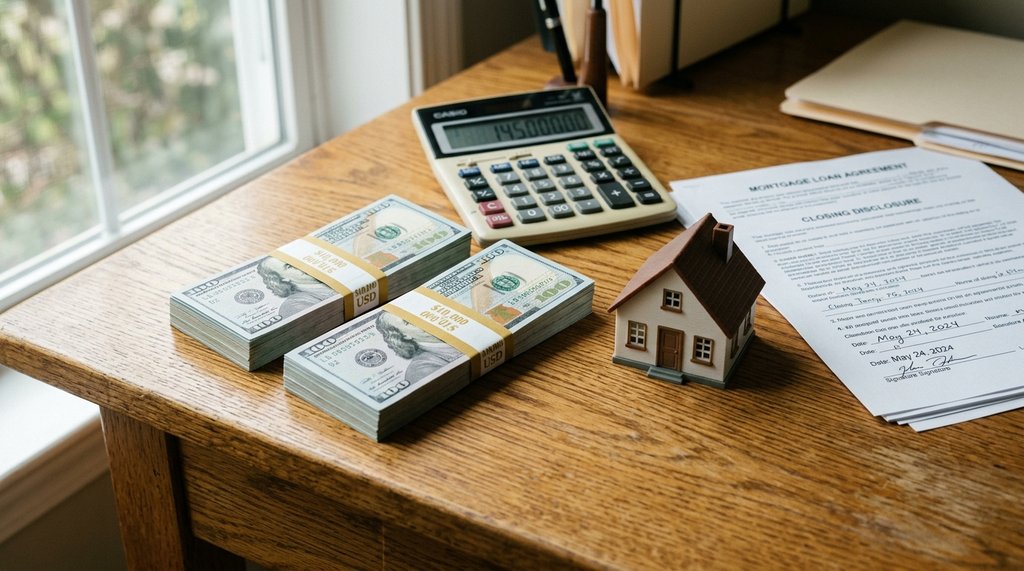
How a Larger Down Payment Changes Your Monthly Bill
Most buyers focus on saving a bigger down payment to avoid PMI, but the monthly payment difference goes much further than that one fee.
The PMI Story Is Only Half the Picture
Private mortgage insurance gets all the attention whenever someone talks about putting less than 20% down. It typically adds $50 to $200 per month, depending on the loan size and your credit score. That is real money, but it is not the biggest lever at work.
A larger down payment also shrinks the principal you borrow, which directly reduces the base payment before insurance is even factored in. On a $400,000 home, going from 10% down ($40,000) to 20% down ($80,000) cuts the loan from $360,000 to $320,000. At a 6.8% fixed rate over 30 years, that alone drops your principal-and-interest payment by about $265 per month, on top of eliminating PMI.
Running the Real Numbers on a $400,000 Home
At 6.8% on a 30-year fixed loan, a $360,000 balance produces a principal-and-interest payment of roughly $2,355. Add estimated PMI of $150 and you are at $2,505 before taxes and insurance. The same rate on a $320,000 balance gives you a base payment of about $2,090, with no PMI. The monthly gap: $415. Try the mortgage payment estimator to see your own numbers.
Over 30 years, that $415 difference compounds into roughly $149,400 in total extra payments for the lower-down-payment buyer. Some of that difference is recovered if the invested cash earns a strong return elsewhere, but most buyers are not running that arbitrage. They are just spending more each month without realizing how much the down payment choice locked in.
The interest cost gap is equally striking. The 10%-down buyer pays around $488,000 in total interest over 30 years; the 20%-down buyer pays about $433,000. That $55,000 spread does not include the PMI premiums paid in the early years, which can add another $10,000 to $15,000 before the threshold is reached.
When a Smaller Down Payment Actually Makes Sense
Keeping cash in hand has legitimate uses. If your emergency fund is thin, draining savings to hit 20% down can leave you exposed the moment the furnace breaks or a paycheck disappears. Lenders want to see reserves, and so should you.
There is also an opportunity-cost argument. If you have a diversified investment account earning 8% to 10% annually, parking an extra $40,000 into a home equity position earning the equivalent of your mortgage rate can look less attractive in a rising market. The calculation depends heavily on your actual rate, your real investment returns, and your tax situation. Most buyers benefit from seeing the numbers side by side before deciding, which is exactly what a home loan payment calculator can show you in under a minute.
One Number That Down Payment Size Cannot Fix
Your interest rate matters more than your down payment in some scenarios. A buyer putting 20% down at 7.5% ends up with a higher monthly payment than a buyer putting 10% down at 5.5%, assuming similar loan amounts. Chasing a lower rate through points or timing the market can outperform an extra year of aggressive saving for a bigger down payment.
The practical takeaway is that no single variable determines affordability on its own. Down payment size, rate, loan term, and local property tax rates all interact. Changing one without adjusting the others produces misleading conclusions. Plug each scenario into a mortgage payment estimator to see how the variables trade off in your specific situation rather than relying on rules of thumb that were written for a different rate environment.